Bulkhead Replacement & Rebuild on Barnegat Bay, NJ
There is a point where a lagoon bulkhead is past repair. The vinyl or timber is split in runs, the piles are gone, the tie-backs are shot, and the wall leans out over the bay. New anchors on a wall that far gone are money after a lost cause. That is when a full replacement is the honest money, and Barnegat Bay Bulkhead builds new walls across the Toms River, Brick, and down-bay lagoon communities.
We replace tired 1960s timber and failed early vinyl with new vinyl sheet-pile bulkheads built for these lagoons: a driven face, a proper wale and tie-back system anchored in stable ground, filter fabric, clean backfill, and a cap that ties it together, often raised to your town's post-Sandy elevation. Built this way a new wall outlasts the one it replaced by decades.
Why Vinyl Replaced Timber Here
The original lagoon walls were timber, and timber rots at the tide line, splits in the ice, and gives the marine borers a meal. Vinyl sheet-pile does none of that. It is inert in brackish bay water, drives to a clean straight line, and has become the default replacement wall on Barnegat Bay for good reason. Where an owner wants a timber look we can cap and whaler vinyl with wood, but the wall that fights the bay is vinyl.
The Chance to Raise the Wall
A replacement is also the moment to fix the elevation. After Sandy, many towns raised their bulkhead standards, and bringing the cap up while the wall is already open is far cheaper than doing it later. We tell you what your town allows and whether a raise makes sense for your lot, so the new wall answers the flood as well as the erosion.
Anchors and the Continuous Run
A lagoon bulkhead is only as good as the run it belongs to. We set new tie-backs and deadmen in stable ground, drive the toe to the embedment the wall needs, and tie the returns into your neighbors' walls so the bay cannot find a gap at the property line. A wall that steps or leaves a joint fails at that joint first.
Built to the NJDEP Permit
A new or raised wall on the bay runs through the New Jersey Department of Environmental Protection, CAFRA where it applies, and a tidelands license or grant. We prepare the application for the wall we build, and where a living shoreline would satisfy the reviewers on a suitable bank we tell you plainly.
Ready to stop patching a wall the bay has already beaten? Call (732) 555-0164 for a free replacement estimate priced by the foot.
How long does a new vinyl bulkhead last on the bay?
A vinyl sheet-pile wall with good tie-backs and a solid cap should give you thirty to forty years on these lagoons, often more. Vinyl does not rot like the original timber and does not corrode in brackish bay water, which is why it is now the standard on Barnegat Bay. The life of the wall is set by the anchoring and the toe more than the panel, so we build those to outlast the sheathing.
Can I raise the bulkhead when I replace it?
Usually, and after Sandy it is often the smart move. Many Ocean County towns raised their bulkhead elevation standards after 2012, and a replacement is the natural time to bring the cap up to the new line for real flood protection. How high you can go depends on your town's standard, your neighbors' walls, and the NJDEP. We tell you what is allowed and what it buys you.
Do you match the new wall to my neighbors' bulkheads?
We tie into them properly. On a lagoon the bulkheads run continuously from lot to lot, and a new wall has to meet the neighbors' walls at the property lines without leaving a gap the bay can exploit. We set the new wall on line, tie the returns into the adjoining bulkheads, and coordinate the cap height so the run stays continuous. A wall that steps or leaves a gap fails at the joint.
What does a full bulkhead replacement cost on the bay?
Waterfront wall work is priced by the linear foot, and a full vinyl replacement on these lagoons usually runs from about $350 to $650 a foot depending on wall height, whether the cap is raised, access, and how much old timber has to come out. A standard sixty-foot lagoon lot is a different job from a wide corner lot on the open bay. Every replacement gets a free written estimate with the per-foot rate and the conditions that drive it.
Can you get equipment to a tight lagoon lot?
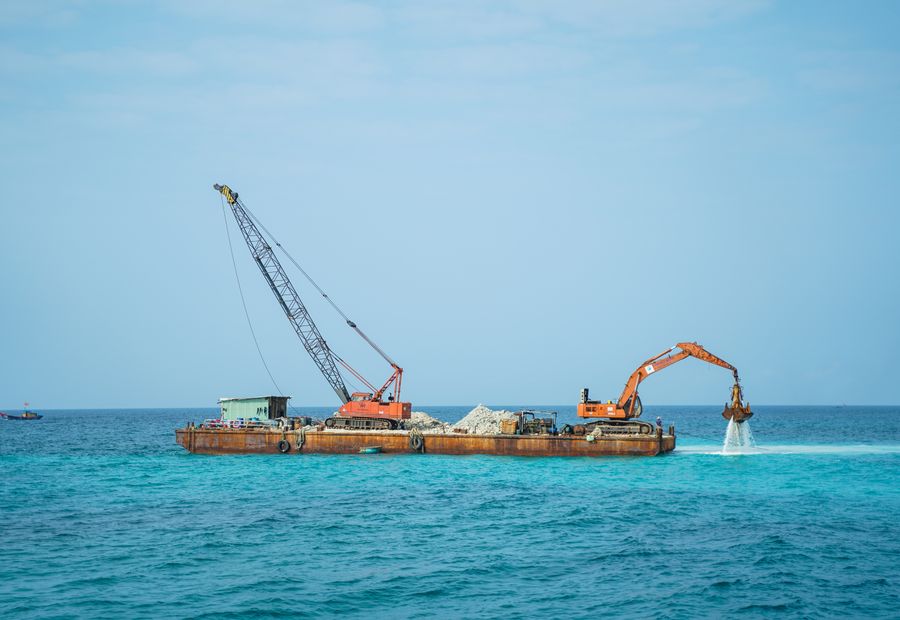
Usually, and it is part of how we price the job. Many lagoon lots have room to work from the upland side; tight lots, corner lots, or walls with no land access get worked from a barge down the lagoon. We read the approach on the first visit, because access is a real cost on these narrow lots and a hidden access problem is how a cheap quote turns into a change order.