Vinyl & Sheet Pile Bulkheads on Barnegat Bay, NJ
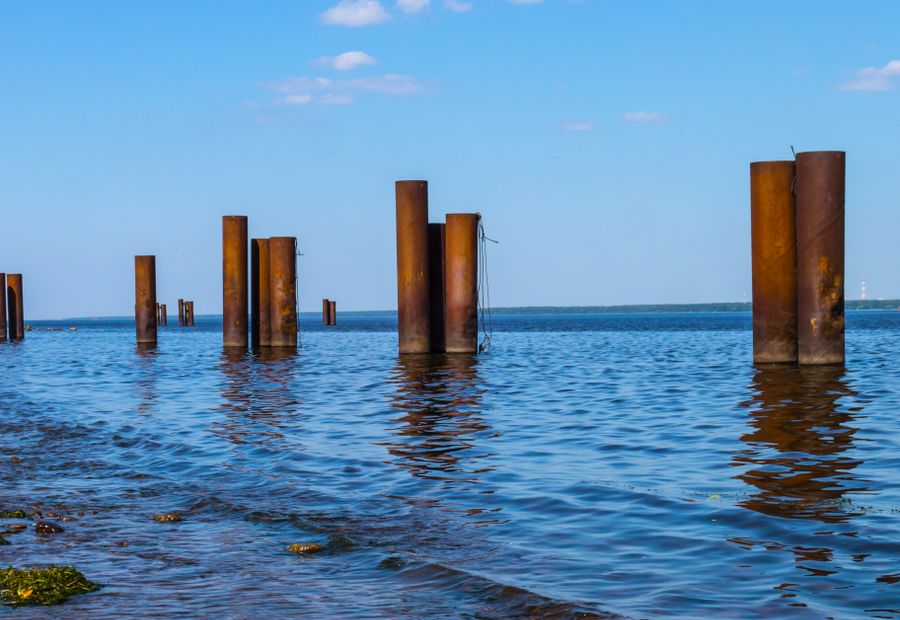
The face of a modern bulkhead on Barnegat Bay is sheet pile: interlocking panels driven into the lagoon bottom to make a continuous wall. Barnegat Bay Bulkhead builds and repairs vinyl, composite, and steel sheet-pile walls across the Toms River, Brick, and down-bay lagoon communities, and on these shallow brackish lagoons the material choice matters as much as the driving.
Why Vinyl Won on the Lagoons
The original walls here were timber, and timber rots at the tide line, splits in the winter ice, and feeds the borers from the water side. Steel rusts in salt water without protection. Vinyl does neither. It is inert in brackish bay water, it drives to a straight, tight line in the sandy bottom, and it has become the default lagoon wall for those reasons. A vinyl wall with good anchors and a deep toe routinely gives thirty to forty years here.
When Composite or Steel Earns Its Place
Vinyl is not the answer to every wall. A taller wall, a high surcharge from a structure near the top, or a deeper corner-lot face can ask for the stiffness of composite sheet pile. The tallest and hardest-driven walls use steel, coated or protected against the salt. We size the section to the wall's height, the soil, and the load, so you are not paying for steel you do not need.
Toe, Ice, and the Tie-Back
A sheet-pile wall stands on what is driven below the mud and leans on what anchors it back in the yard. On the bay, the toe also has to beat the winter ice that tries to lift the wall out of the bottom. We drive the toe to the embedment the wall and the ice demand and set tie-backs and deadmen in stable ground, with filter fabric behind the sheathing so the lagoon cannot pull your backfill out through the interlocks.
Finished, Not Plastic
The driven panel is capped and whalered in timber or composite, and that finish is what you see from the yard. It is a replacement wall built of the one material the bay cannot rot, split, or rust.
Planning a vinyl or sheet-pile wall? Call (732) 555-0164 and we will size the material, the toe, and the anchors to your lagoon.
Which is best for a lagoon wall, vinyl, composite, or steel?
For almost every residential lagoon wall on Barnegat Bay, vinyl. It does not rot or corrode in brackish bay water, it drives cleanly into the sandy bottom, and it costs less than steel. Composite is stiffer for taller walls or higher loads behind them. Steel is for the tallest walls and hardest driving and needs coating or protection in salt water. We match the material to your wall height, the soil, and the water depth rather than selling one system for every lot.
Will vinyl sheet pile handle the winter ice?
Better than timber does. Ice on the bay grabs and lifts, and it splits and heaves old timber walls and their piles. Vinyl flexes rather than splitting, does not soak up water that then freezes, and with a proper toe and anchors it rides the seasonal ice far better than the walls it replaces. We set the toe deep enough that ice cannot lift the wall out of the bottom.
Does vinyl look like plastic on the water?
Not the way it is finished. The driven panel does the structural work below and just above the water line, and it is capped and whalered in timber or composite on top, which is what you see from the yard. Vinyl comes in muted gray and tan tones, not bright white, and a good cap makes it read as a finished bulkhead rather than a plastic fence.
How deep does the sheet pile have to be driven?
Deeper than the part you see. A bulkhead is a tied or cantilever wall, and much of its strength is the length driven below the mud, the toe. In the soft, sandy lagoon bottom the toe has to be deep enough to resist kick-out and ice lift, and a tied wall carries part of its load back to the anchors. We size the toe and the tie-backs to the wall, because a wall driven too shallow leans or lifts no matter how good the face looks.